Amazing in scope, brilliant in depth and a source of credible information
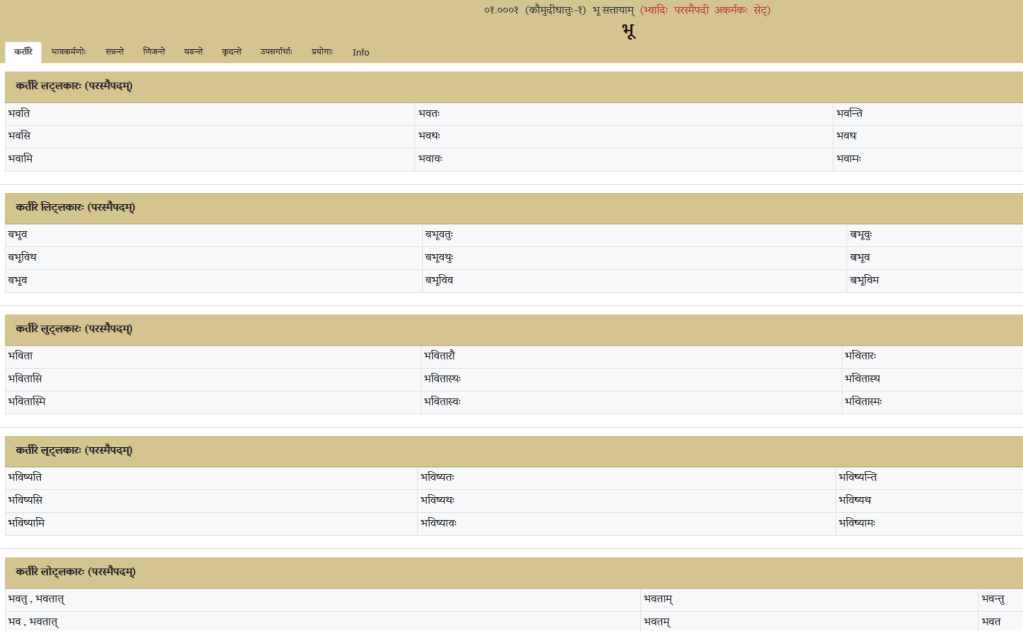
Dhatu Patha
धातुः is the root of all Sanskrit words!
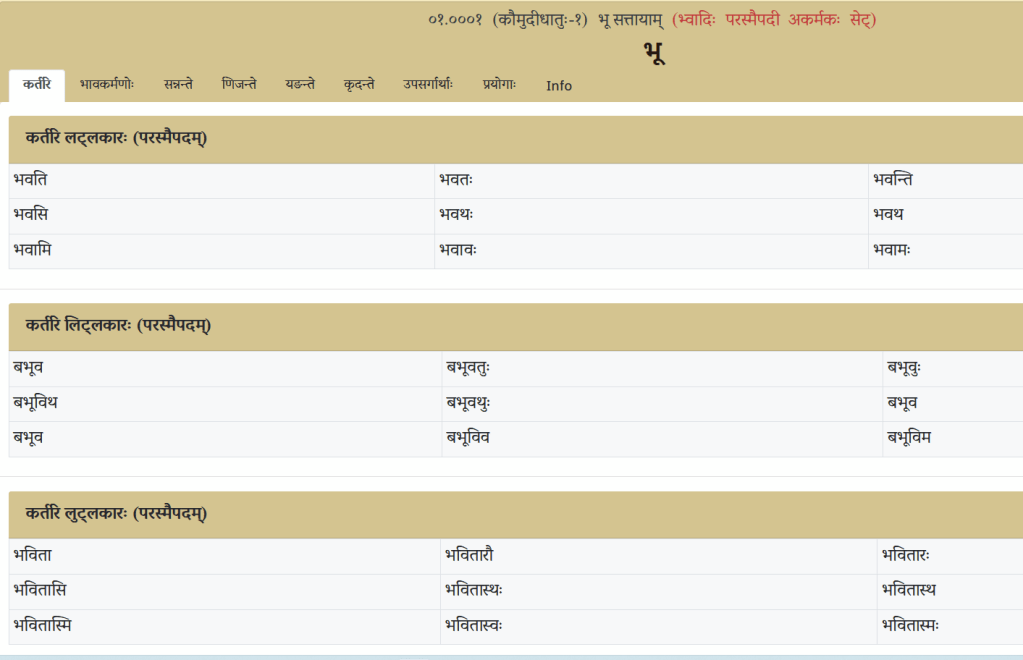
An example is भू which is defined as सत्तायाम् (being, existence).
Each dhatu is categorized differently from a grammatical perspective (भ्वादि, अकर्मक etc)
Dhatu patha gives a list of all the ‘roots’ from which all other word forms are generated.
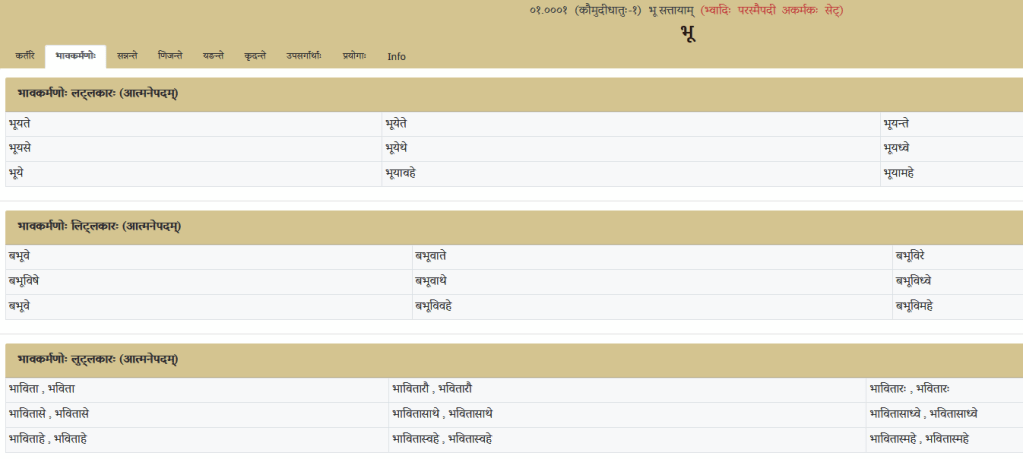
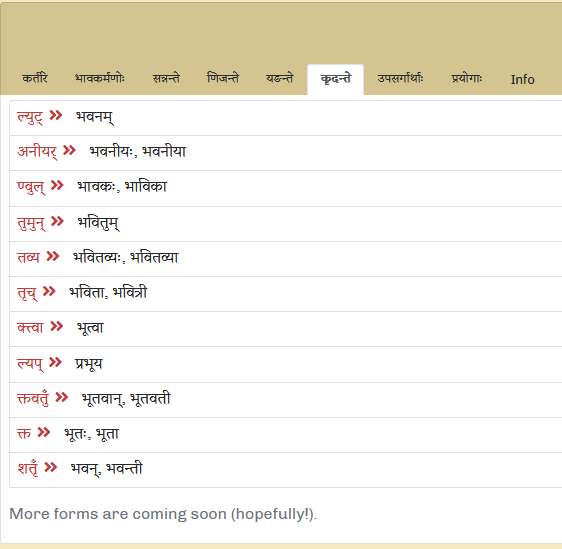
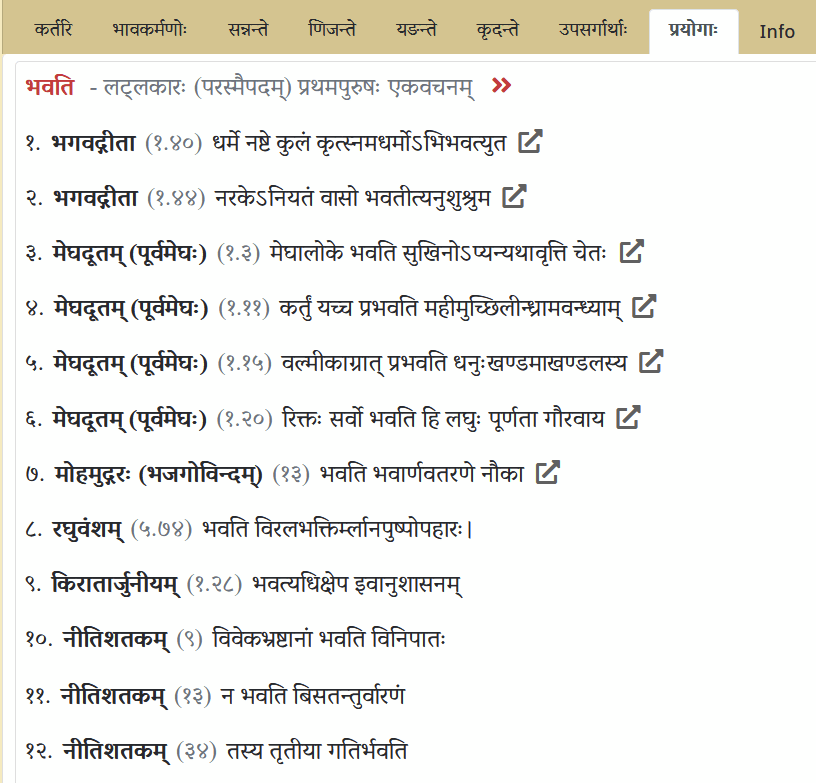
Clicking on each Dhatu gives you the various forms like Lakaras (verbs) – Kartari and Bhavakarmani forms, Sannanta, Nijanta, Yunganta as well as the important Kridanta and Upsaraga forms.
In the case of some dhatus, typical usages are also provides
For experts, it is interesting to note that by clicking on each word form, you can get the prakriya (derivation process) also in a pop-up
Very cool!
Shabda Patha
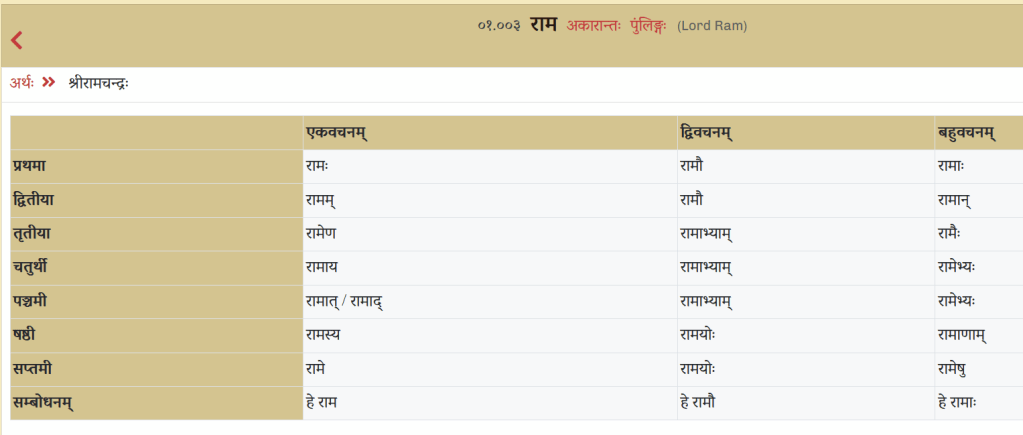
Shabda Patha gives a list of common noun forms and their Vibhakti (inflected) forms
Example: the typical अकारान्तः पुंलिङ्गः form is exemplified by रामः।
Sutra Patha
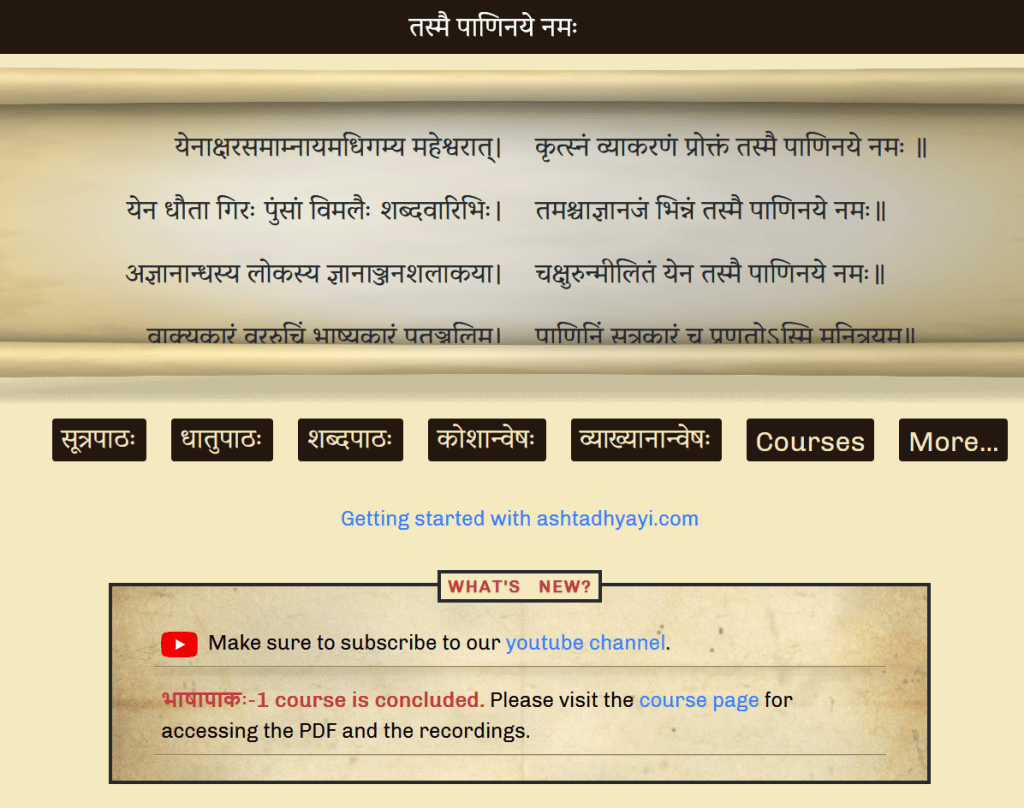
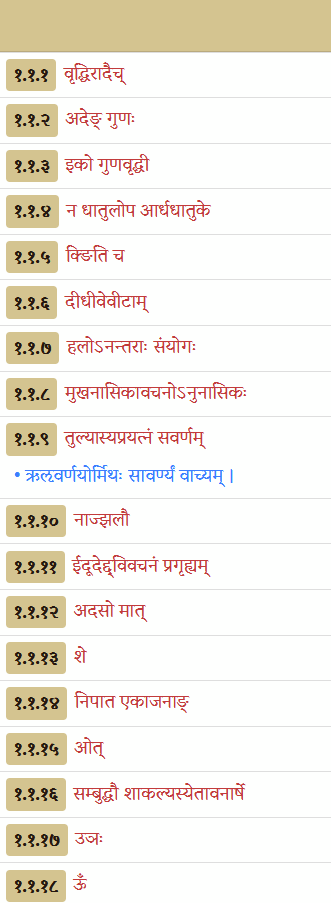
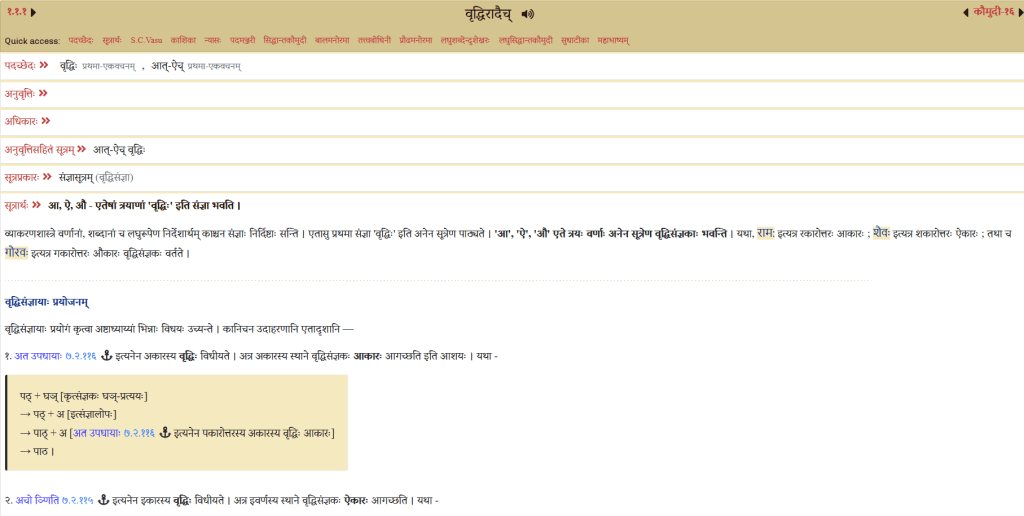
The Sutra Patha gives a list of all the Paniniya Sutras and their commentaries along with explanations
The Right Hand Menu provides a list of critical resources including Ganapatha as well as Unadi Pathas
Ashtadhyayi.com is a treasure created by Shri Neelesh Bodas and team. This is something each and every Samskrita student should be using every day
For those who are interested in more details, these are provided in my old thread attached below
Unlike many Bhashas, multiple possible readings are reduced/avoided in a संस्कृतम् sentence via integrated word+विभक्तिः combination [Inflection]
Options to parse are reduced
Clues – रावण [ म् ] is a द्वितीया vibhakti form which means he can’t be the कर्ता [ DOER ] but has to be the कर्म्म [ the object of action ].
राम [ः] is the प्रथमा vibhakti form which signifes the DOER
So by the specific use of प्रथमा and द्वितीया vibhakti forms, any confusion as to who killed whom avoided!
Vibhakti provides contextand relationships
Combined word+विभक्तिः format avoids many ‘interpretation’ issues
रामस्य means Rama’s
रामेण means by Rama
रामाय means – for Ram [का।को।से।ने।में] in Hindi & [of / by / for/ in] in English. This causes scrambling in meanings, unless rigidly tied to the word {as राम के & राम ने are different}
word+ विभक्तिः also provides CONTEXT within a sentence
रामः-प्रथमा-DOER
रावणं-द्वितीया-OBJECT of action
वने-सप्तमी-location
अस्त्रेण-तृतीया-causative
रावण cannot be DOER since रावणम् is द्वितीया & hence Karma (object/receiver of action)
Word-position within a sentence immaterial
Also, Samskritam ‘rule’ of यल्लिङ्गं यद्वचनं या च विभक्तिर्विशेष्यस्य तल्लिङ्गं तद्वचनं सा च विभक्तिर्विशेषणस्यापि means adjectives must have same vibhakti, linga & vachana as the noun
कुरुवृद्धः पितामहः – प्रथमा
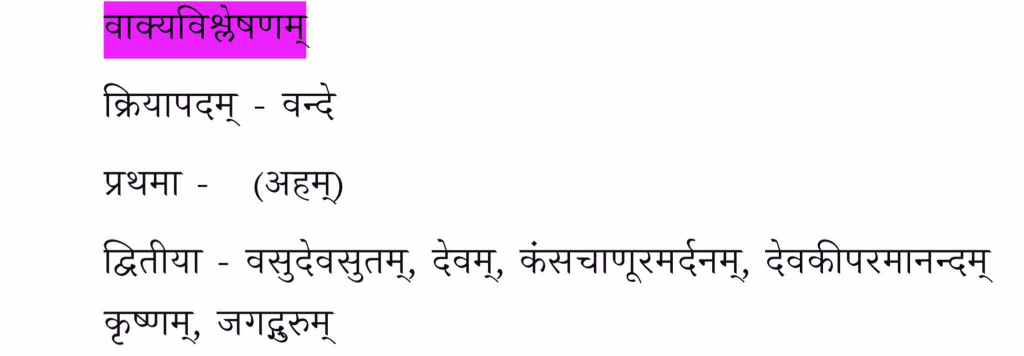
वसुदेवसुतं देवं कृष्णम् – द्वितीया
By grouping similar विभक्ति words, we can find out which all are related in a sentence
All प्रथमा words will be कर्ता or विशेषण of कर्ता
द्वितीया words will be कर्म or विशेषण of कर्म
Hence, even if scrambled, we can unzip the correct combinations via विभक्तिः। Brilliant!
So while we mug up रामः रामौ रामाः in the beginning, we typically don’t realize the significant payoff we get at the end of the process
– the ability to write scrambled order euphonic verses that retain fidelity of meaning
-Unmatched accuracy in transmission of meaning
-Flexibility
विभक्तिः is a powerful concept – unfortunately turned into a beginner’s rote learning nightmare!
The ability to maintain fidelity of meaning irrespective of word position provides amazing opportunities Hence, grammatically correct संस्कृत sentences are a thing of beauty !
As Patanjali Maharishi mentions in the Mahabhashya एकः शब्दः सम्यग्ज्ञातः शास्त्रान्वितः सुप्रयुक्तः स्वर्गे लोके कामधुग्भवति।
Even ONE word, learnt fully well, used correctly according to rules will bring you whatever you wish for; not only in this world, but also the heavens
Post Script
For a brilliant exemplar of the type of analysis made possible by these Samskritam grammar rules (vibhakti), please read this thread analyzing the faulty translation as well as the logical/grammatical issues pertaining to ‘Arthashastra’ raised by the redoubtable @kmadathil
Read on…
What Kautilya says here is that use pratyaksha (perception), anumana (inference) and sabda (authoritative testimony) to critically inquire what is good & bad policy, strong & weak knowledge system…and that constitutes the basis of all dharma.
Let’s look at the original. Chapter 2 starts with आन्विक्षिकी त्रयी वार्ता दण्डनीतिश्च विद्याः “Anvikshiki”, the vedas, economics, and political science are the four vidyAs. Anvikshiki is defined later. He then presents alternate views, but later reasserts his position
चतस्र एव विद्याः इति कौटिल्यः, he reasserts – these four are indeed the vidyAs, unlike what other schools say. ताभिर्धर्मार्थौ यद्विद्यात्तद्विद्यानाम् विद्यात्वम् By these are known what is dharma, and what is artha, and that is the essence of vidyA (knowing what is “right”)
साङ्ख्यं योगो लोकायातं चेत्यान्वीक्षिकी “AnvIkshikI” is defined as Saankhya, Yoga, and Lokayata. A glaring omission is nyAya and/or vaisheShika. Commentators say he did intend this to be a synecdoche for all other दर्शनानि, but that’s speculation.
धर्माधर्मौ त्रय्यामर्थानर्थौ वार्तायां नयापनयौ दण्डनीत्याम् The vedas define what is dharma/adharma. Economics defines artha/anartha. Good and bad policy is determined by politics.
बलाबले चैतासां हेतुभिरन्वीक्षमाणा लोकस्योपकरोति व्यसनेऽभ्युदये च । बुद्धिमवस्थापयति प्रज्ञावाक्यक्रियावैशारद्यं च करोति।
By pondering the strength and otherwise (of the topic at hand) by these (veda/economics/politics) one helps society, keeps ones mind steady in good and bad times, and gains good sense, and ability in word as well as deed. (implying that this is the point of education)
प्रदीपः सर्वविर्यानामुपायः सर्वकर्मणाम् । आश्रयः सर्वधर्माणां शश्वदान्वीक्षिकी मता । This is the final verse – Kautilya tends to add a verse that summarizes the chapter, but is also often tangential. Here he seems to be putting AnvIkShikI on a higher pedestal
The light of all knowledge, the means of all action. The eternal base of all dharma, AnvikShiki is considered to be. Does he contradict here his earlier statement specifically privileging veda, economics, and politics as the source of all judgement?
It is definitely feasible, but slightly shaky to think that he does. Using the Indian convention of the whole illuminating the part, we should probably to prefer the interpretation that AnvikShiki trains the mind to make better arguments *on the basis of his preferred bases*
Alternatively, we could interpret this as using अन्विक्षिकी in the literal sense of “inquiry”, rather than as the definition he’s made a while ago.What is missing here is the reference to प्रत्यक्ष, अनुमान etc, the pramANas. These are first seen in the nyAya sUtras, and we’ve seen that Kautilya specifically *does not mention* nyAya. It would be strange if he were using AnvIkShikI to mean those and never even mentions nyAya
I have to say *I* prefer a more critical approach than Kautilya does, but that’s different from saying that *that was what he said*.
Point of clarification. Why do I call it a faulty translation? The translator says “enquire through logical reasoning into the triple” (ie veda/economics/politics) . The original has बलाबले चैतासां हेतुभिरन्वीक्षमाणा. “Enquire into strengths and weaknesses through these”
The anaphora एतासां cannot be interpreted to mean AnvIkshikI (even if we take the translators interpretation of the word as “logical reasoning”) for simple grammatical reasons – it is in the grammatical feminine plural. AnvIkshikI is singular.
What if we take the components of AnvIkshikI separately and construe as plural? The constituents are grammatically masculine and neuter, and by the Paninian rule नपुंसकमनपुंस्केन … the collection has to be grammatically neuter (hence एतेषां, not एतासां)
What does that leave us with? Given the context, we need a feminine collection, and that could be the four vidyAs including AnvIkshikI, or the three not including it. So the veda/economics/politics are the *means* (हेतु) of enquiry for Kautilya not the subject, as translated.
How do I read these long, incomprehensible sentences in संस्कृतम् ?
Do you freeze when faced with a Samskritam sentence like this?
ओङ्कारपञ्जरशुकीमुपनिषदुद्यानकेलिकलकण्ठीम् ।
आगमविपिनमयूरीमार्यामन्तर्विभावये गौरीम् ॥
दयमानदीर्घनयनां देशिकरूपेणदर्शिताभ्युदयाम् ।
वामकुचनिहितवीणां वरदां सङ्गीतमातृकां वन्दे ॥
Do you tell yourself “this is too complex! I am never going to understand it” ?
If so, fret not!
By understanding the simple rules of Sandhi, you can easily start to enjoy the beauty of Samskrita Poetry as well as elegant prose!
Why Sandhi?
Samskritam prizes practicality, poetry and precision. So when writing Samskritam poetry or even complex sentences, we ‘merge’ individual words into continuous ‘sounds’. This causes ‘Sandhi’ to occur between individual words.
The resulting ‘merged’ longer phrase follows the sound laws human speech inevitably need to align as per the anatomical limitations of our speech organs!
Example:
गण + ईशः = गणेशः (not गणयीशः)
वाक् + ईशः = वागीशः (not वाकीशः)
Sandhi makes the sentence shorter, precise, easier to pronounce as well as euphonious
What is Sandhi?
संहितायां सत्यां वर्णविकारः।
संहिता is when letters (sounds) come extremely ‘close together’ when we speak
When संहिता occurs, a change in the letters or sounds (VarnavikaraH) also happen
Whenever such a change occurs, we call it a Sandhi
This short 2 minute video from Vyoma provides and overview of Sandhi
What is सन्धिः (Sandhi) ? When does सन्धिः happen?
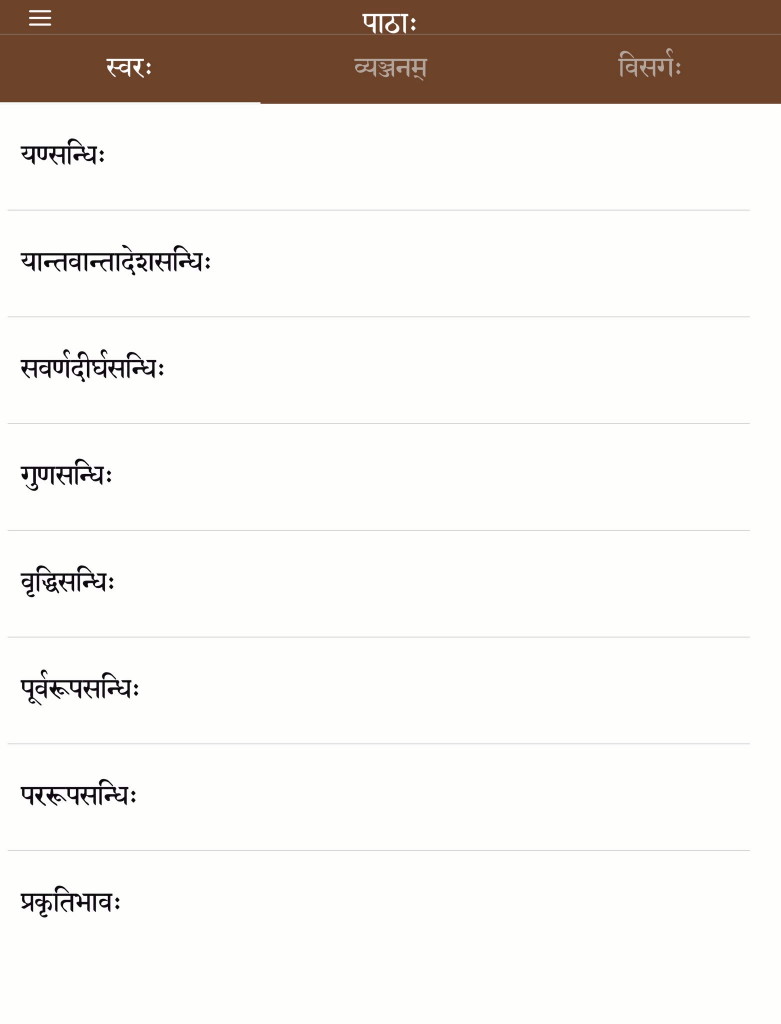
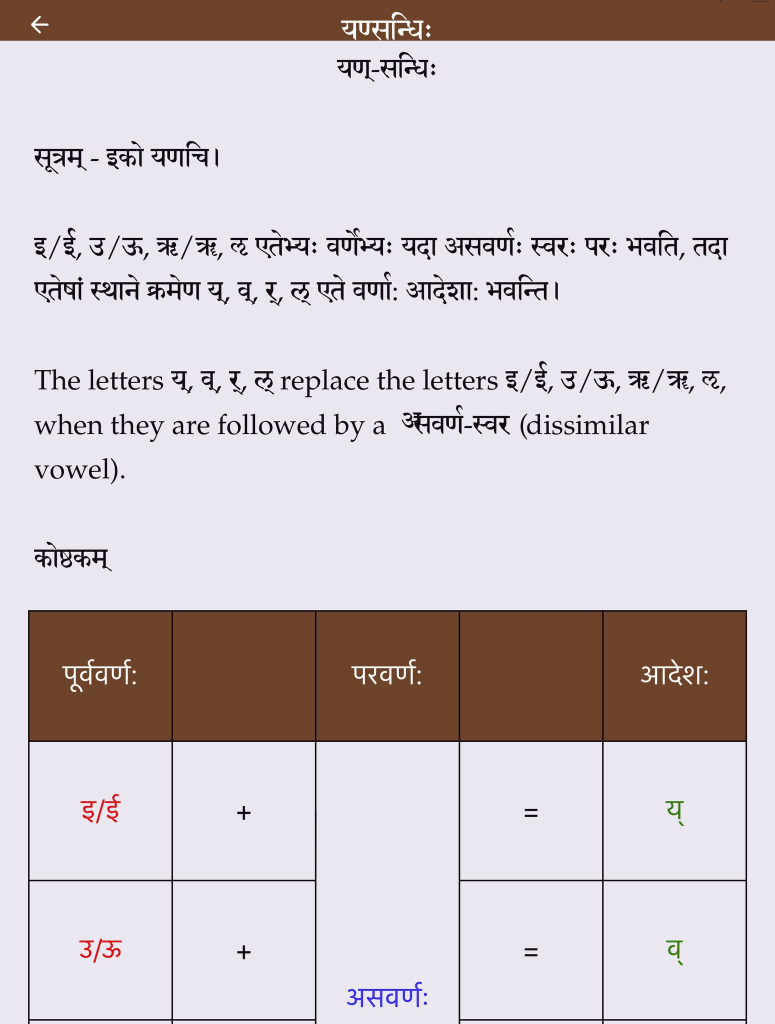
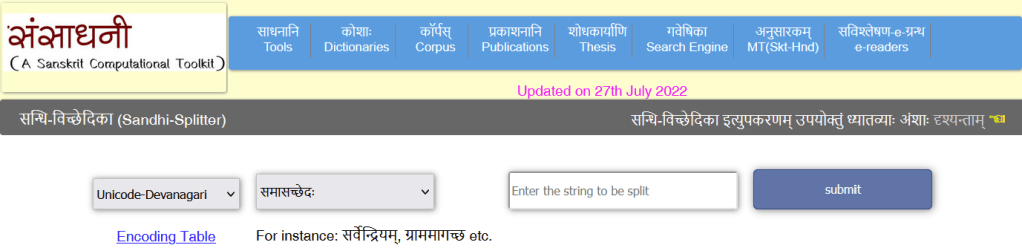
The सन्धिः app has (a) Information about Sandhi (b) rules & examples for each Sandhi (c) exercises to practice Sandhi
(A) Basic introduction to Sandhi
(B) List of Sandhis, rules & examples for each rule
(C) Exercises for Sandhi – joining & splitting
Now that we understand the cause and need for Sandhi, how do we ‘unfreeze’ our brains when faced with
ओङ्कारपञ्जरशुकीमुपनिषदुद्यानकेलिकलकण्ठीम् ।
आगमविपिनमयूरीमार्यामन्तर्विभावये गौरीम् ॥
दयमानदीर्घनयनां देशिकरूपेणदर्शिताभ्युदयाम् ।
वामकुचनिहितवीणां वरदां सङ्गीतमातृकां वन्दे ॥
To unpack shlokas, as we have seen in the Anvaya process, the first step is to break sentences into component words. Then we can try to figure out the meaning
We will start off with breaking up the Sandhis + generating the simple meaning of words
ओङ्कार + पञ्जर + शुकीम् उपनिषद् + उद्यान + केलि-कलकण्ठीम्
वरदाम् सङ्गीत-मातृकाम् वन्दे। २ Bestower of boons – music – mother – Vande
I contemplate (विभावये) upon Gowri in my heart (अन्तः) – Gowri, who is the she-parrot (शुकी) residing in the cage (पञ्जर) of ओङ्कार, the cuckoo (कलकण्ठी) sporting (केलि) in the garden (उद्यान) of Upanishad (उपनिषद्), and the peahen (मयूरी) in the forest of Veda (आगमविपिन)
I contemplate (विभावये) upon Gowri in my heart (अन्तः) – Gowri, who is the she-parrot (शुकी) residing in the cage (पञ्जर) of ओङ्कार, the cuckoo (कलकण्ठी) sporting (केलि) in the garden (उद्यान) of Upanishad (उपनिषद्), and the peahen (मयूरी) in the forest of Veda (आगमविपिन)
Why is it रामेण & not रामेन? Why गणेशेन & not गणेषेण ?
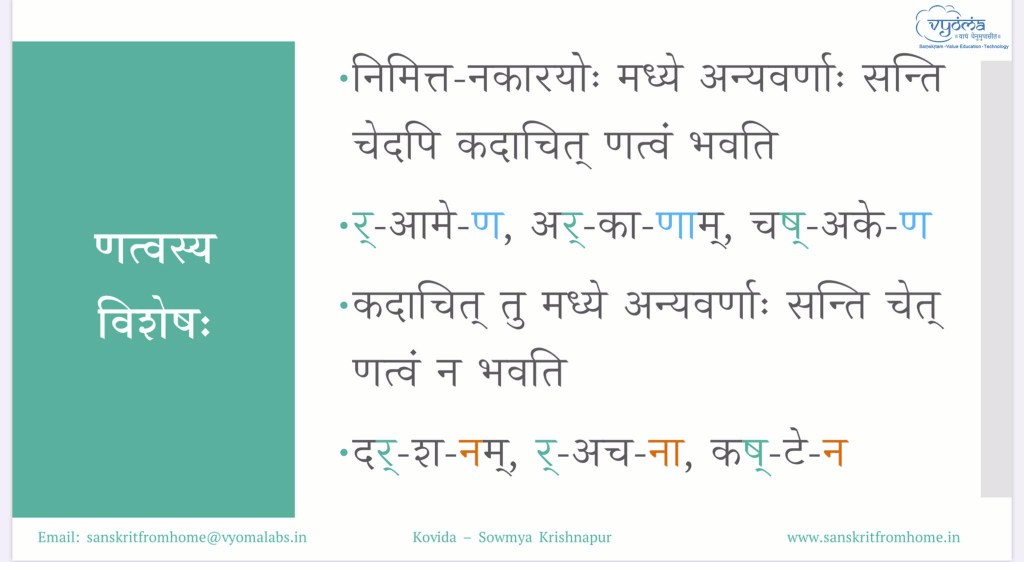
न—>ण – A quick intro
The Basic Rule
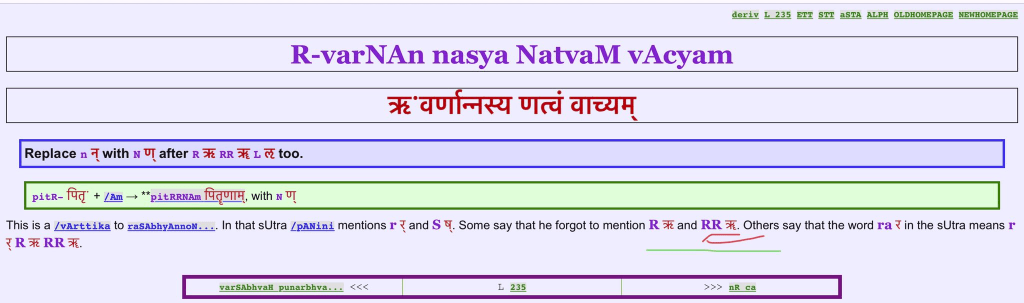
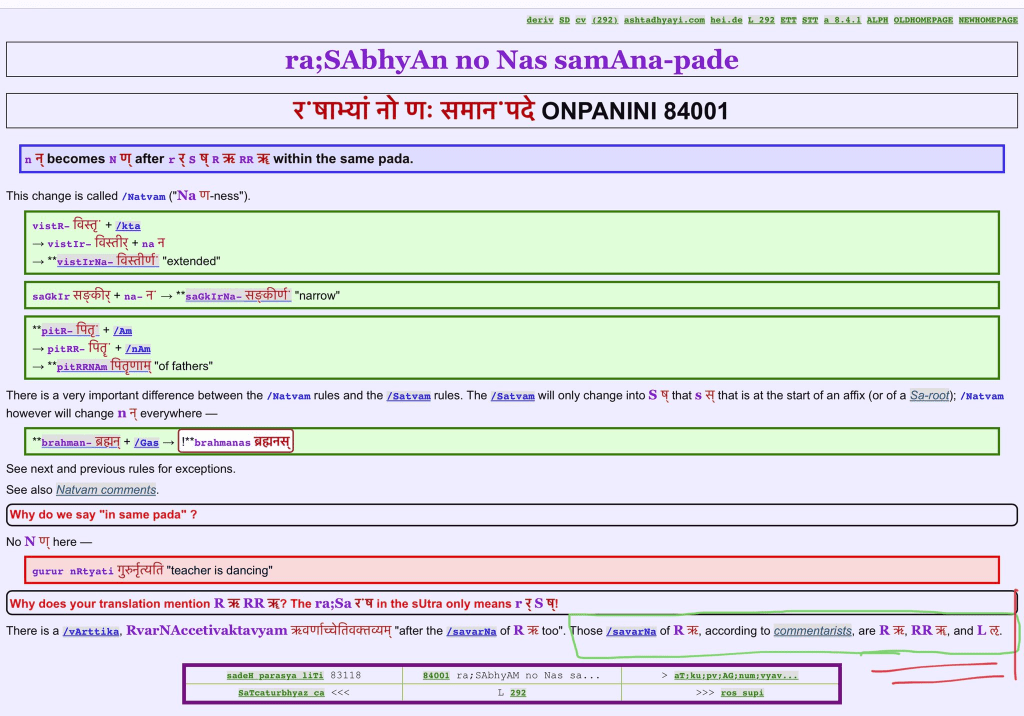
न becomes ण in the presence of र् ऋ or ष्
If these letters are immediately preceding न्, then न->ण is ALWAYS transformed
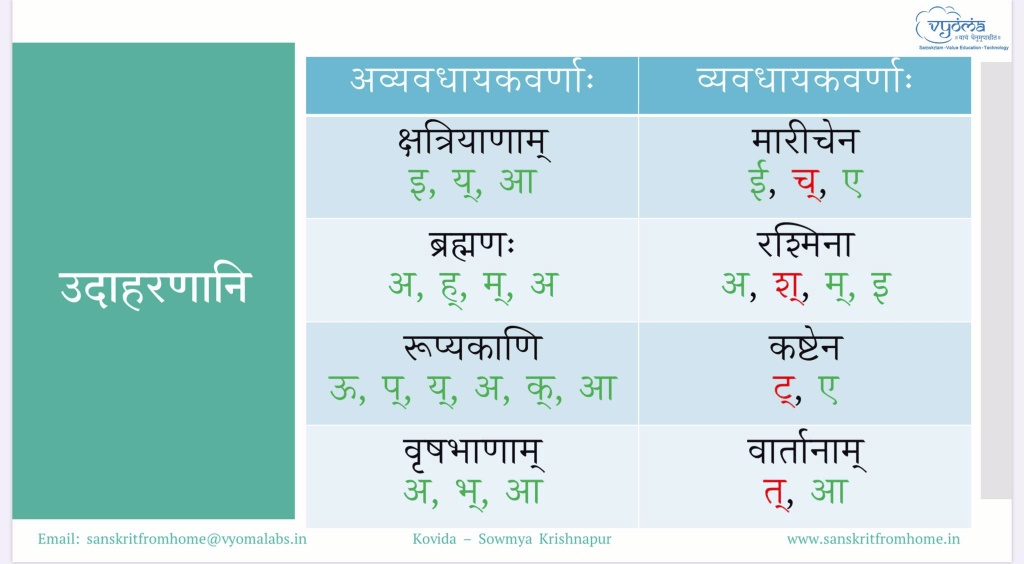
However, if there are intervening letters between न and र् or ऋ or ष् , depending on the nature of the intervening letters णत्वम् occurs
स्वराः हयव कवर्गः पवर्गः cause णत्वम्।
Others block णत्वम्।
EXAMPLES
Special Rules and Conditions: Please Note
णत्वम् is a rule WITHIN a word
If the न् is at the end of a पदम् – no णत्वम् occurs. Example: रामान्
णत्वम् does not occur between the 2 component words of a Samasa – since these are joined-together words. Example: रामनाम
However, in the case of Proper Nouns (संज्ञावाचकपदः) णत्वम् is possible
The most famous example is रामायण -> राम + अयन (the path of Rama).
While it is a समासः, it signifies a proper noun
To get a quick overview of णत्वम् , here is a 2 minute intro from the Vyoma Samskrit Kovida series by @SKrishnapur
A 2 minute intro from the Vyoma Samskrit Kovida series by @SKrishnapur
PS: It is interesting to note that while Ashtadhyayi covers only रेफः & षकारः in the sutra रषाभ्यां नो णः समानपदे ८।४।१ there is a Vaartika which adds others – including ॠ
Break up words & sandhis. Here you generate the list of ‘free-standing’ component words
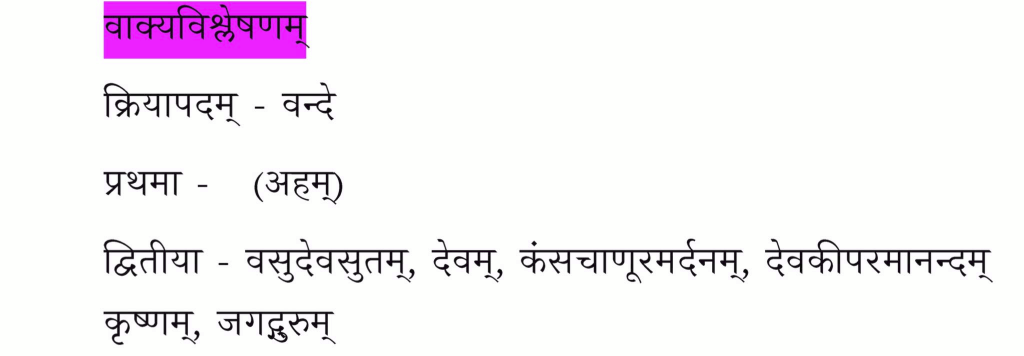
Then do वाक्यविश्लेशणम् . You take each of the identified words and then characterize them based on whether they are a verb, a noun, an adjective etc. This process is critically dependent on understanding the Vibhakti also
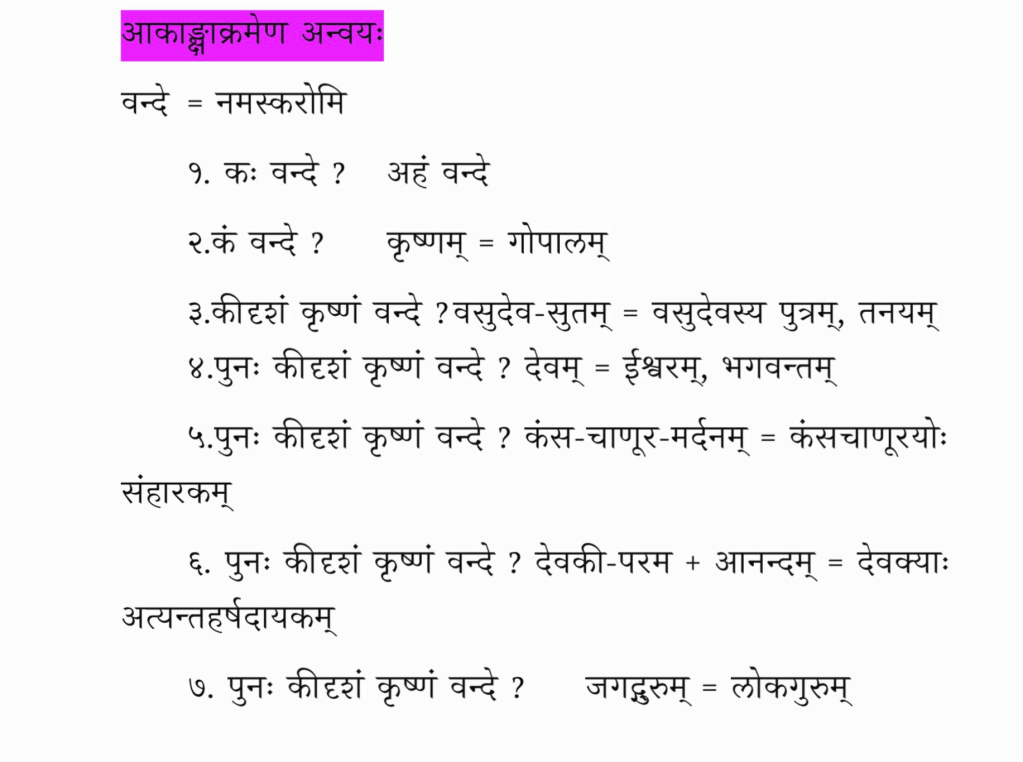
Once you have identified the individual words and then characterized the nature of the words, start the process of आकाङ्क्षाक्रमेण अन्वयः (Unzipping)
Step 1: Identify the verb (क्रियापदम्)
Step 2: Group all “same vibhakti” words
Step 3: Ask ‘questions’ in sequence to each of the words to find their ‘relation’ to the verb
Putting together the ‘answers’ generated, in logical sequence, gives you the anvaya!
Isn’t it brilliant?
Why group same vibhakti words together?
Now why do we have this step?
Because according to the rule यल्लिङ्गं यद्वचनं या च विभक्तिर्विशेष्यस्य तल्लिङ्गं तद्वचनं सा च विभक्तिर्विशेषणस्यापि
The gender, number & case of विशेषण follows विशेष्य in संस्कृतम्!
For example, here words in द्वितीया are all adjectives for the कर्मपद – कृष्णम् (which will always be in द्वितीया in कर्तरि प्रयोगः)
So they are all describing Krishna! So [To Krishna WHO IS.. ]
Why ask questions?
Because, each sentence has ONE verb
विभक्ति shows the relationship between the words and THE verb
प्रथमा-Who?
द्वितीया-To whom?
त्रितीया-By whom?
By asking questions in a sequence, we fully interrogate the relationship between the verb & constituent words!
Start now to master the Anvaya process!
Here are a list of wonderful resources to help you develop and hone your Anvaya skills
To formally learn the Basic Anvaya method & process in a structured manner, there is nothing better than the Shiksha lectures by Sowmya Krishnapur Bhagini
Start from video 1 : from 10 minutes onwards
Here she explains in detail the Anvaya process & runs through many examples
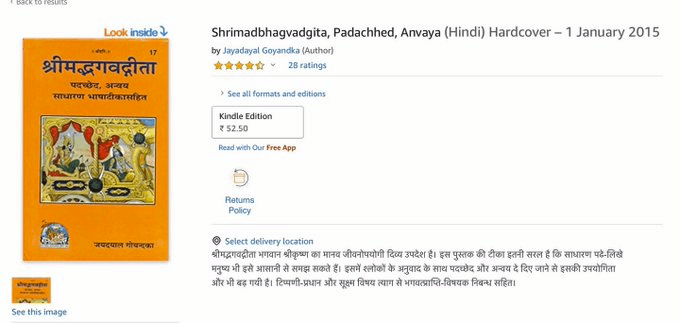
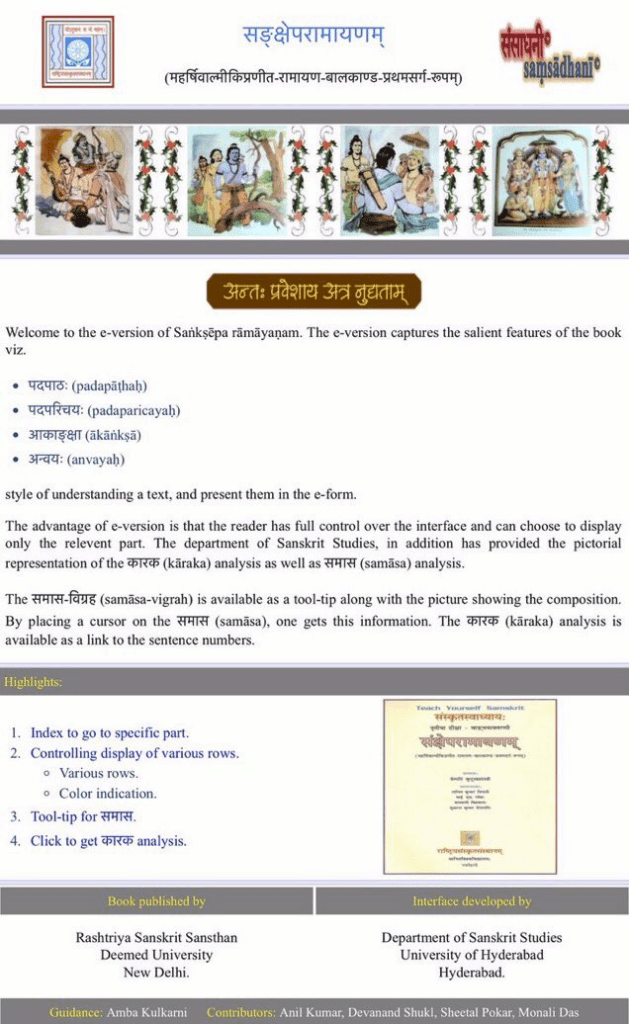
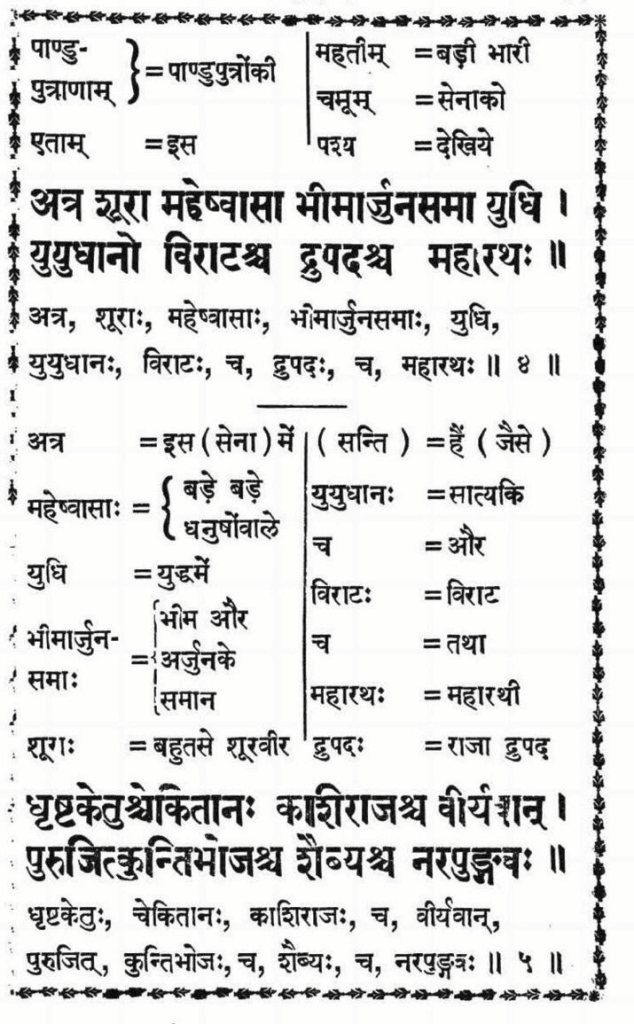
The Ramayana & Bhagavad Gita Supersites by IIT Kanpur are SUPERB to learn & practice how to read scriptures
How do I tweet? How do I write? How do I flex by newly learnt Samskritam skills ?
LifeHacks to become the next Kalidasa !
Problem1: You know what you want to say.
Your ideas are complex, clauses are nested & you appreciate nuance.
But you sure as heck don’t know how to convey all that in Samskritam
All you can manage to write are sentences like ‘Rama reads”, “I go to temple” & “My name is Kalidasa”!
Problem2: You know what you want to say, but the words (Samskritam) fail you…
All the rights words are popping up in your mind, BUT unfortunately in the wrong language.
Maybe in Hindi, Tamil, Axomiya or even Swahili!
Everything except the Samskritam words you are hunting for…
Problem3: You know want you want to say, but you are sure that your sentence sucks!
The spelling is wrong, tenses are wrong, the यल्लिङ्ग-यद्वचन stuff is all over the place and you are mortally scared.
Surely, people will now KNOW for sure that you are a comprehensive idiot!
Not to worry! There is a solution for all problems.
Here is my tried and trusted 10 step approach
You may benefit from this & end up like Kalidasa, not only answering “अस्ति कश्चिद् वाग्विशेषः” but go on to create ‘Kumarasambhavam 2’ or ‘Raghuvamsam 3–The Return of the Nandini!’
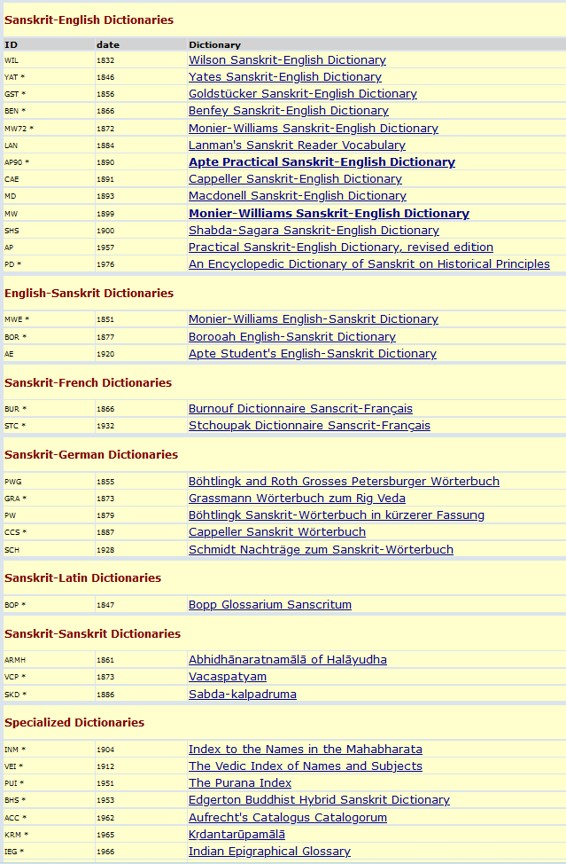
These are wonderful sites that you can use to find words, synonyms, sentences etc.
This can also be used to unscramble sentences written by others
These easy sites are a lifesaver to the beginner and is a MUST in your favourite list
Step 3: Break up sentences
You don’t need to write complex sentences.
Use bite sized pieces
Create complex ideas with a string of simple sentences.
Get started with simple and before you know it, you will be writing complex sentences
Step 4: Don’t worry too much about spellings in the beginning
Ending with म् or Anusvara ? प्र or पृ,?
It’s important to be correct but don’t fret too much in the beginning
You will pick it up along the way & there will always be folks who will nudge you in the right direction
Step 5: Vibhakti – a big bugbear !
Use रामस्य or रामाय? Use प्रथम or द्वितीय?
And what is all this Genitive/Dative stuff?
Shockingly, the vibhakti for the same phrase in your mother tongue doesn’t work with Samskritam!
Again, no worries. Few iterations and you will be OK
Step 6: Definitely mug up vibhakti tables for common sound endings
You should know at least राम, हरि, गुरु, रमा, नदी, फलम्, सः सा, तत्, अहम्, त्वम् before you come in to bat
Similarly, mug up लट्, लृट्, लङ्, लोट् for parasmaipadi+atmanepadi.
The more you know the better it is..
Step 7: Use intelligent short cuts
If you don’t know the formal past tense, use क्तवतु as a great escape hatch: पठितवान्, पठितचती, पठितवत् instead of all the 9 past tense forms
Similarly, क्तवा, तुमुन् and the 7 क question forms (किम्, कुत्र, कदा, कति..) are life savers
Step 8: Know the standard rules
Example – in Kartari sentences, Karta=1, Karma=2 and Verb=Karta & in Karmani, Karta=3, Karma=1 and Verb=Karma OR linga+vachana+vibhakti agrees in a Visheshya/Visheshanam combo
You will then understand the reasoning quickly when folks suggest corrections
Step 9: Internalize the standard high frequency word combinations that help you write simple sentences
You will start to notice many of these combos in sentences & conversations
Soon enough, these catch phrases will stick in your mind.
The only trick is more practice..
Step 10: You will make horrendous mistakes & probably make less sense than a 3 yr old
You will cringe the moment you press that tweet button because you figured out a gross error!
But focus on your common mistakes, internalize them & make daily improvements
To help सहपाठीs possibly avoid this needless confusion, I am sharing snippets from Neelesh Bodas Varya’s wonderful lecture on Lakaras:https://t.co/QrQqpkAqEh
I strongly recommend listening to the entire lecture multiple times!
You want to learn Samskritam. Dive deeper into Bharatiya culture and Dharma.
You are busy. Can I learn Samskritam?
YES – it is QUICK and it is EASY.
How long will it take?
6 months to become familiar. 1 year to read comfortably and follow conversations.
StartupSamskritam #2
How can I Do It?
There are multiple paths.
I am going to share 7 different methods that are available to anyone across the world.
Your schedule is tough. You learn differently. Does NOT matter…
Learn Samskritam When You Want It, Where You Want It!
StartupSamskritam #3
You will find the right approach that will work for you. All you need is a “hunger to learn” and dedication
This is going to be far, far, easier than you expect Ask anyone who has learnt Samskritam over the past 2-3 years – you will hear the same message ..
नैव क्लिष्टा न च कठिना (neither tough nor difficult)
I am Evidence No 1 !
StartupSamskritam #4
Show me HOW ?
I will share 7 options to get started. Works across time, energy or money challenges.
Structured Course
Learning by Speaking
Learning via Shlokas
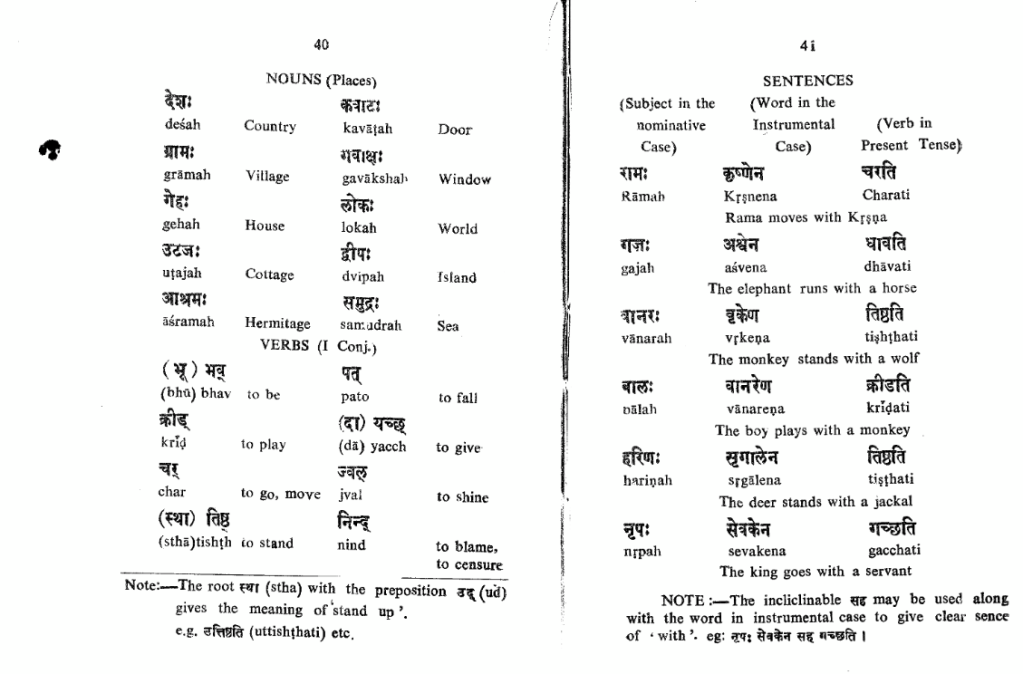
Text Books
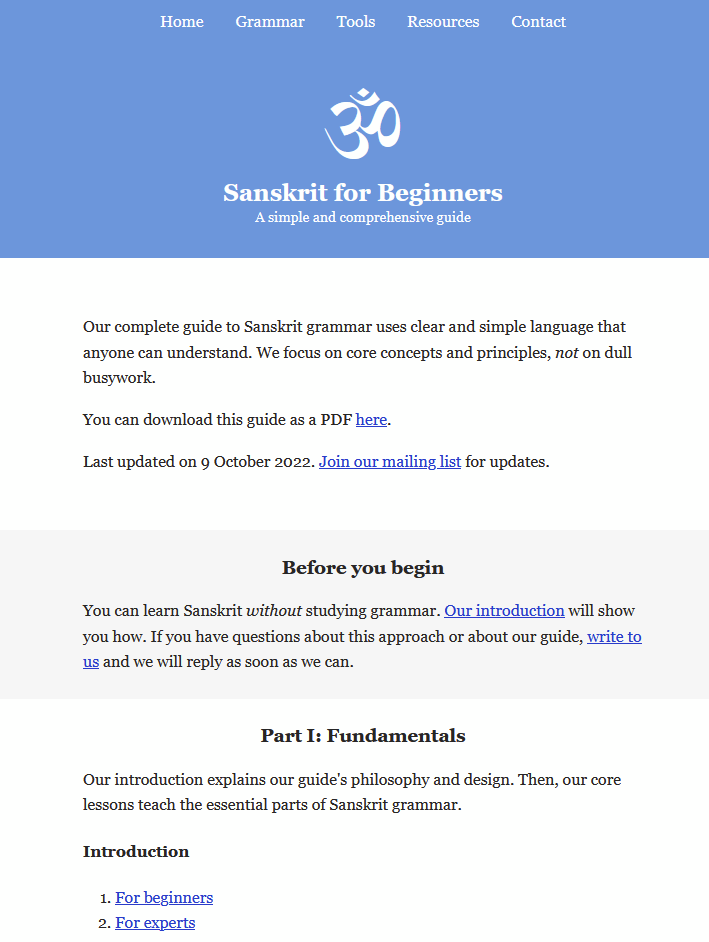
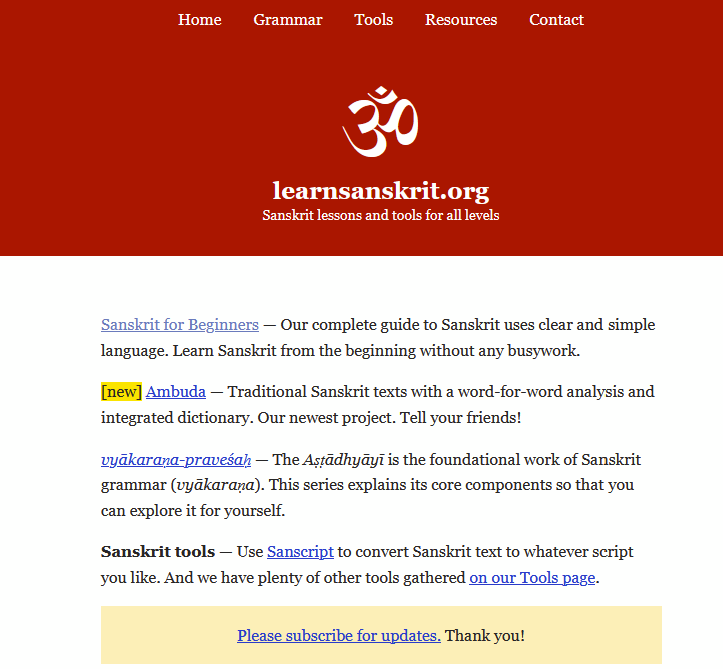
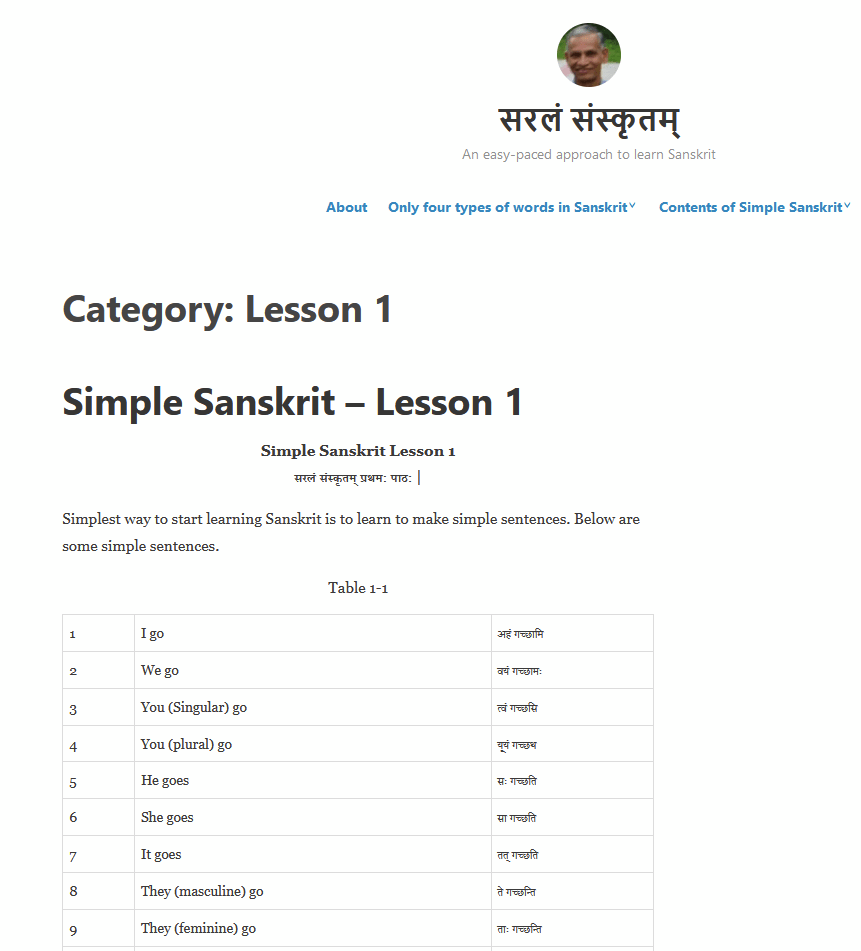
Websites
eLearning Apps and Tutoring
Comics
StartupSamskritam #5
Method 1: Structured CourseWINNER
If you learn better with a pre-designed curriculum which holds your hand with small step-by-step lessons and structured notes + lectures, then a guided “structured course” program may be the right approach for you!
This approach is actually the most popular and also has the maximum chance of success
>90% of learners will succeed using this method
#StartupSamskritam #6
Samskrita Bharati runs the most popular structured program in the world and is the most popular structure course for learning Samskritam
Madras Sanskrit College : This highly renowned Sanskrit educational organization runs an excellent structured Online course ‘संस्कृत प्रवेशिका’ for beginners. The course covers all key introductory topics in an engaging manner. An overview of the course and pedagogy –
Samskrita Bharati has many types of LIVE spoken Samskritam classes. These may be available in your neighbourhood. Check out their website to see if this is an option for you
Learning by Speaking method has many advantages – a natural learning style that is NOT via learning grammar first
You glide in smoothly and start understanding the language’s rhythms and nuances
This is very intuitive, effective and many people swear by this– you may soon be one of them!
If your primary motive behind learning Samskritam is to understand scriptures, shlokas and other matters concerning Dharma, this approach may be right for you
Bonus-you learn Samskritam also while diving deep into Bhagavad Gita or the Ramayana!
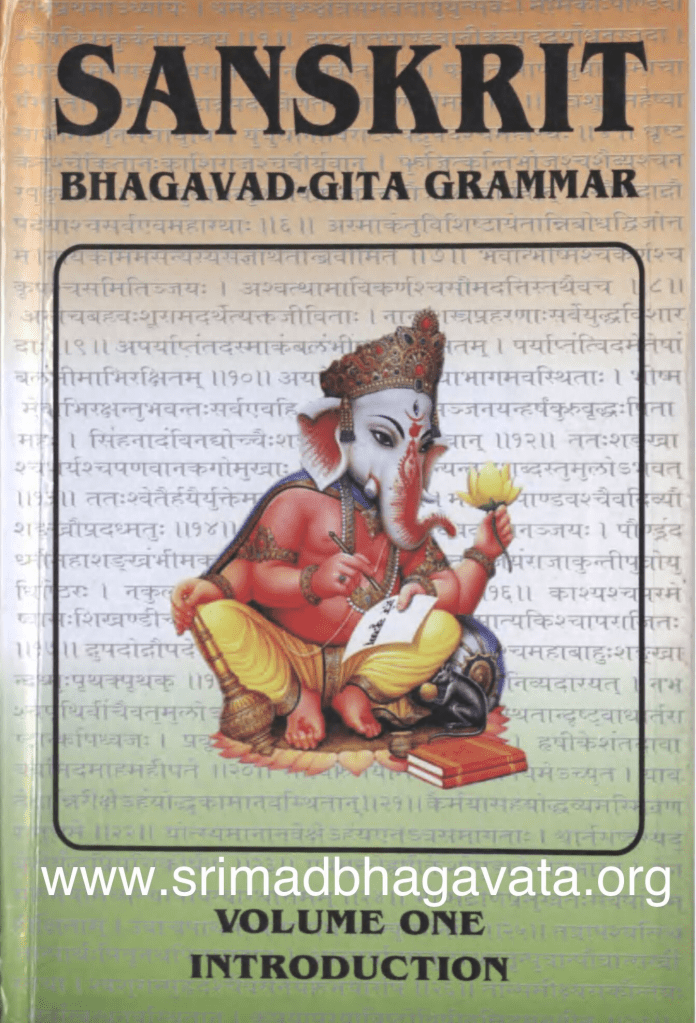
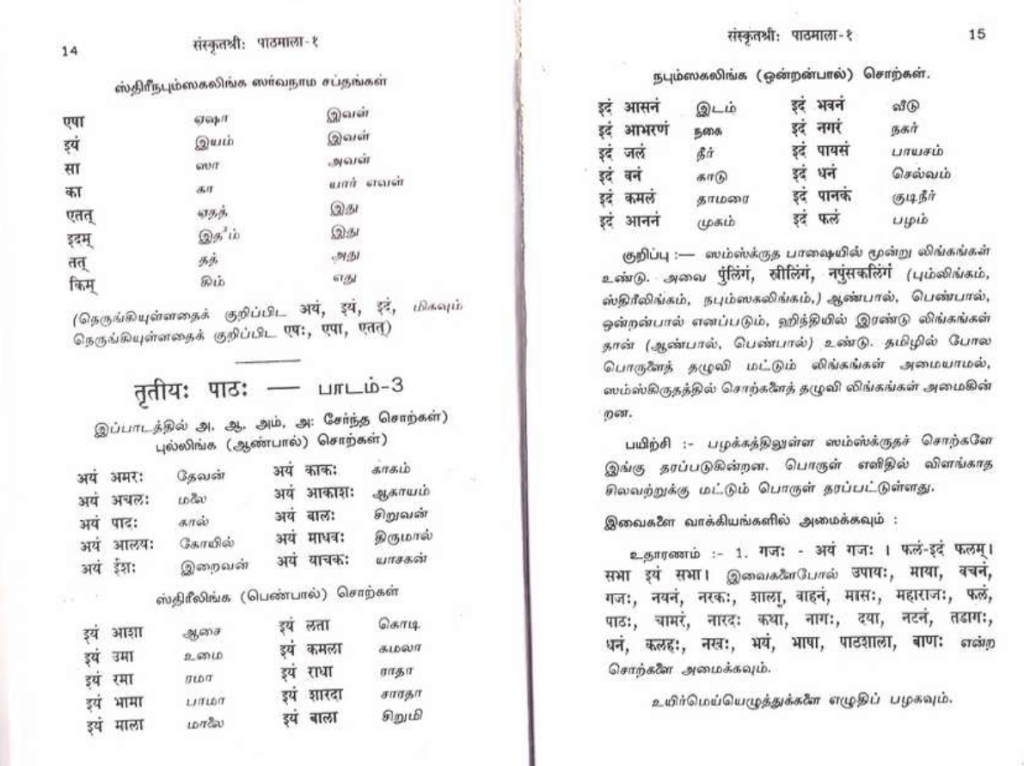
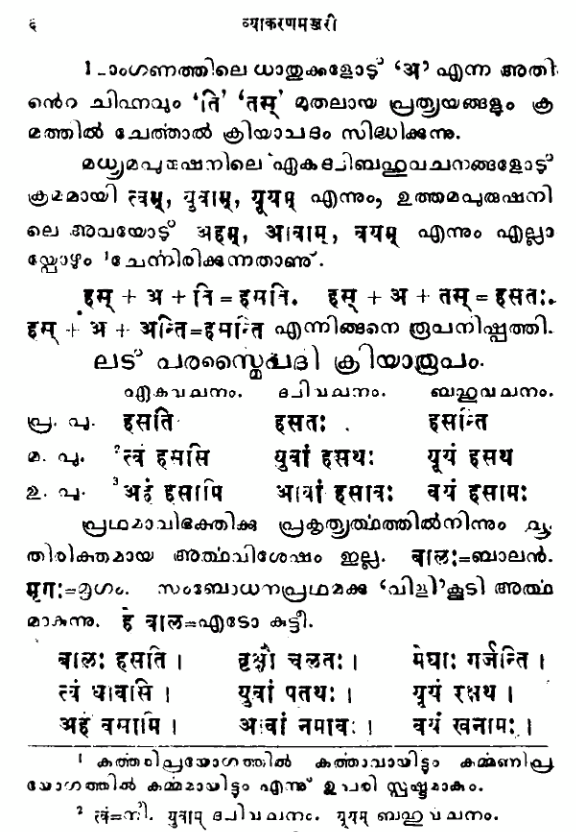
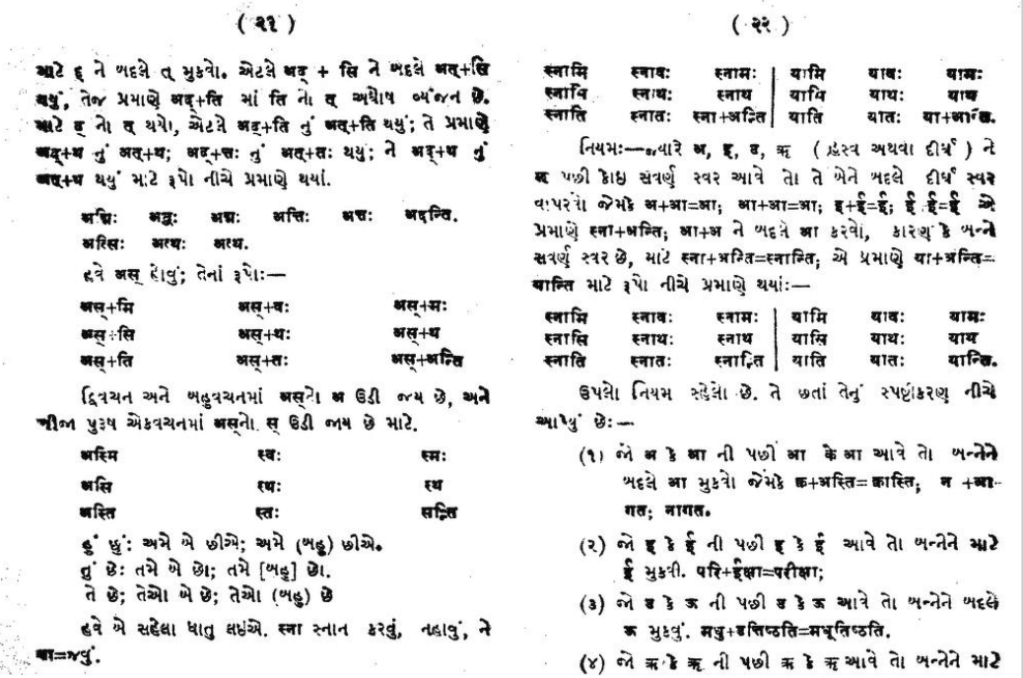
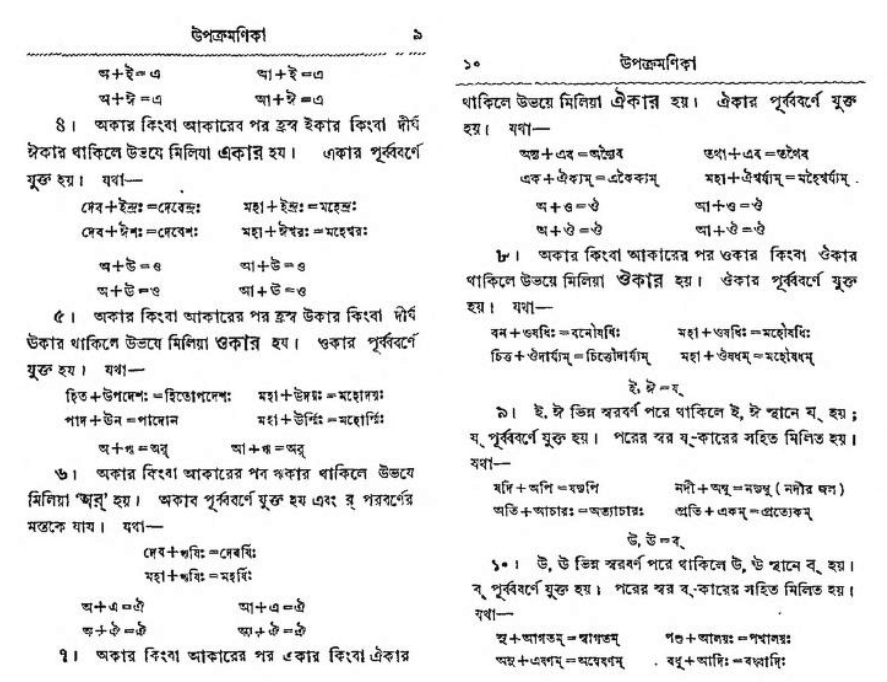
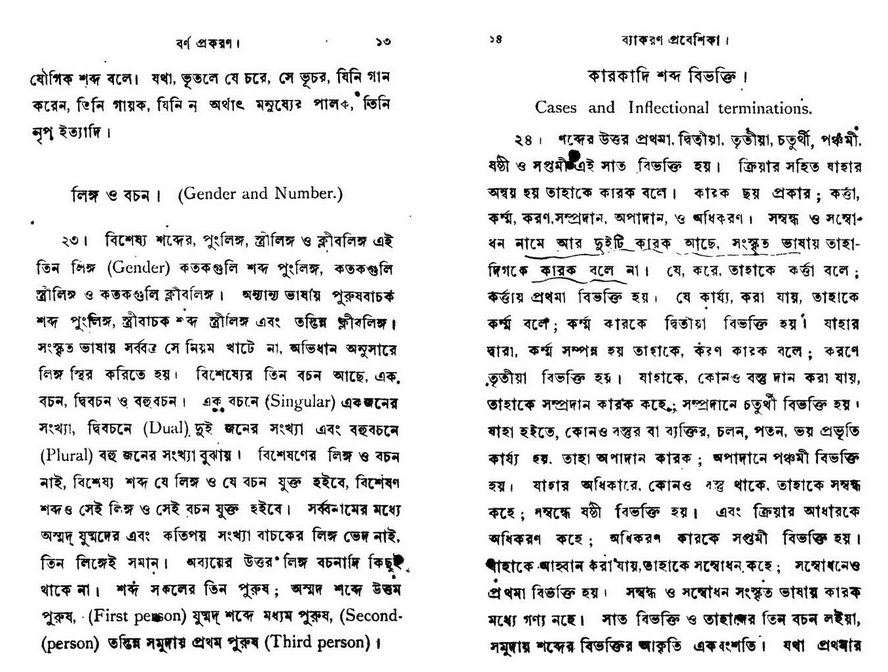
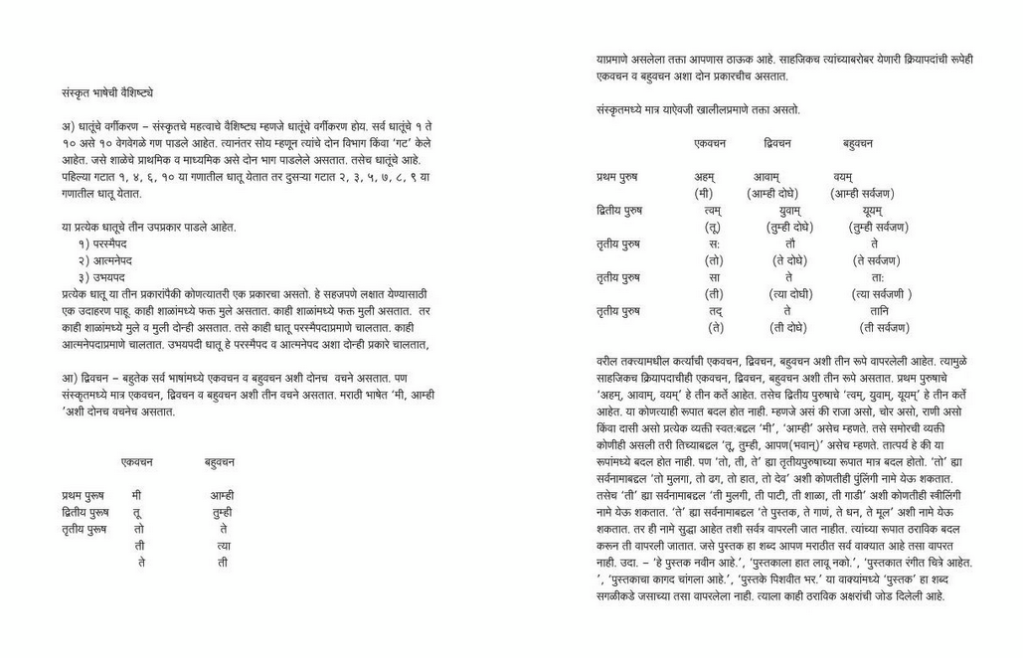
Sanskrit textbooks from State Boards can be a useful source. I have collected textbooks from VI – XII std from 13 state boards (NCERT, CBSE, KA, KL, TN, TG/AP, RJ, GJ, MP, CG, OR, MH & NIOS) at https://t.co/ajnhVfht7b@pvaal2@yaajushi@archan_dave @Madame_Micawber @rivalslayer







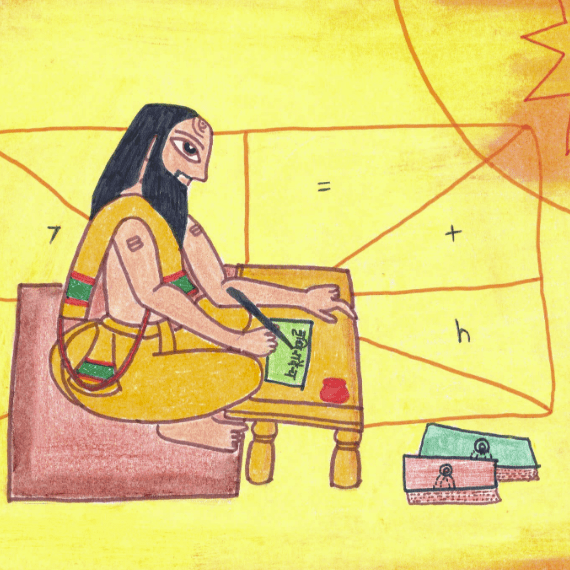






















 Like everything in life, a light touch helps us take stuff in our stride





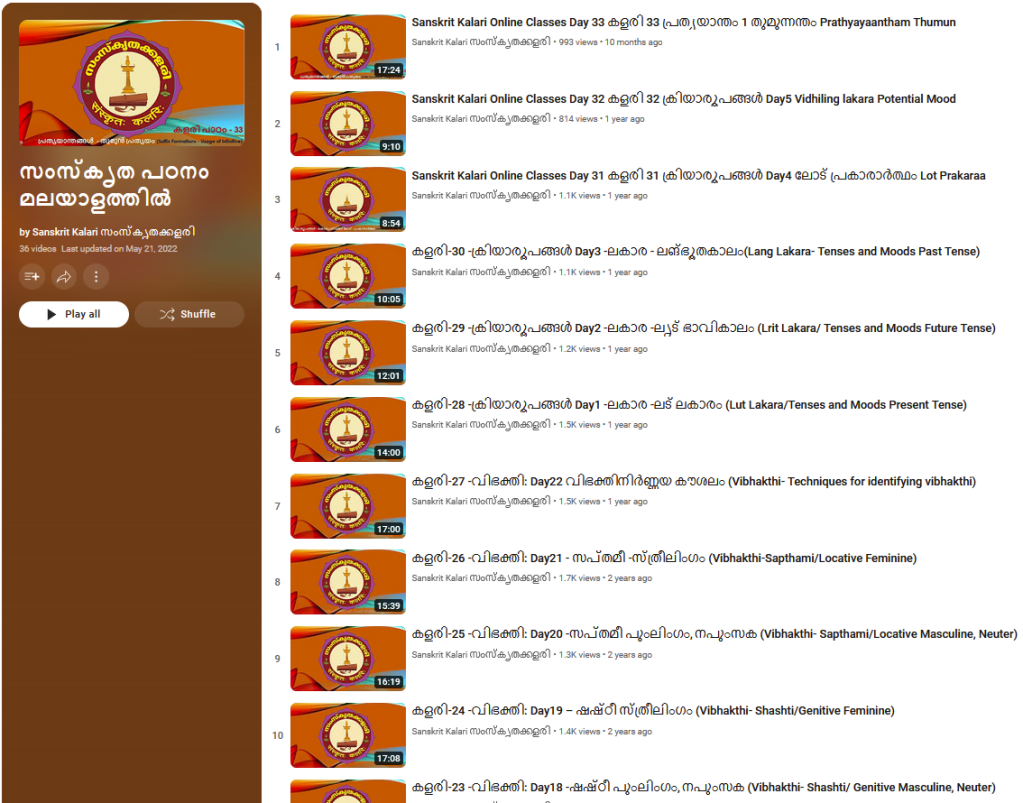
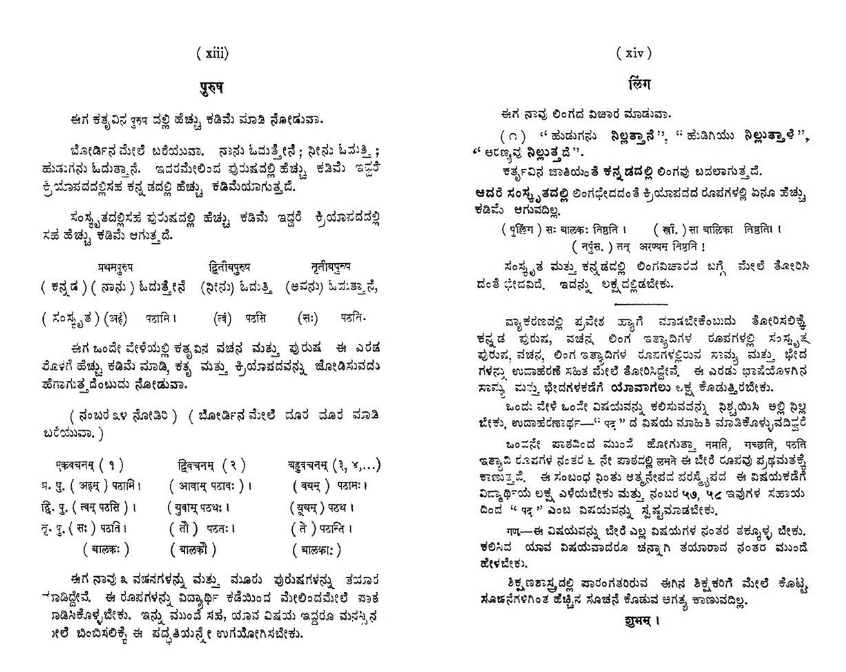
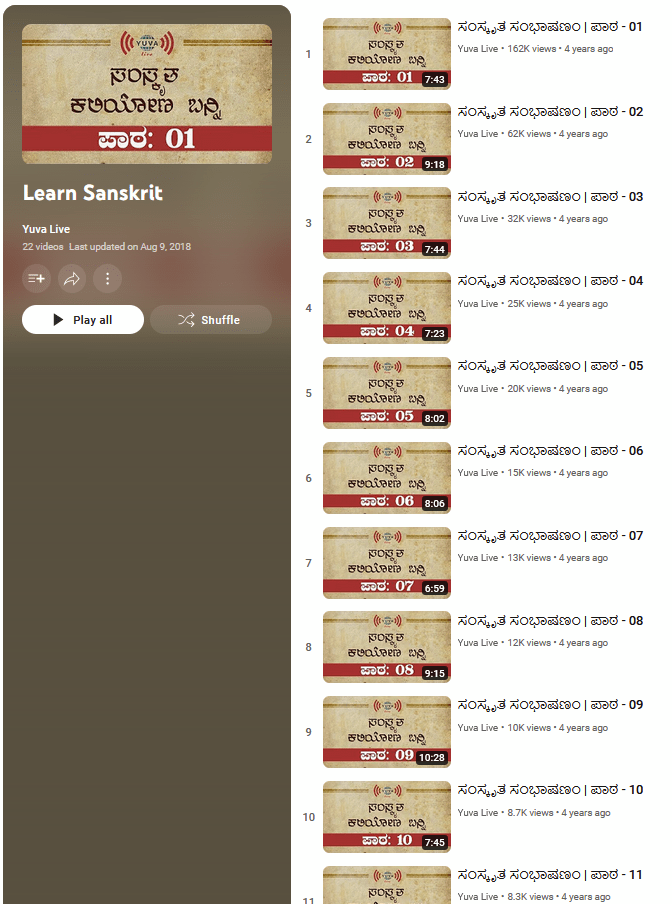


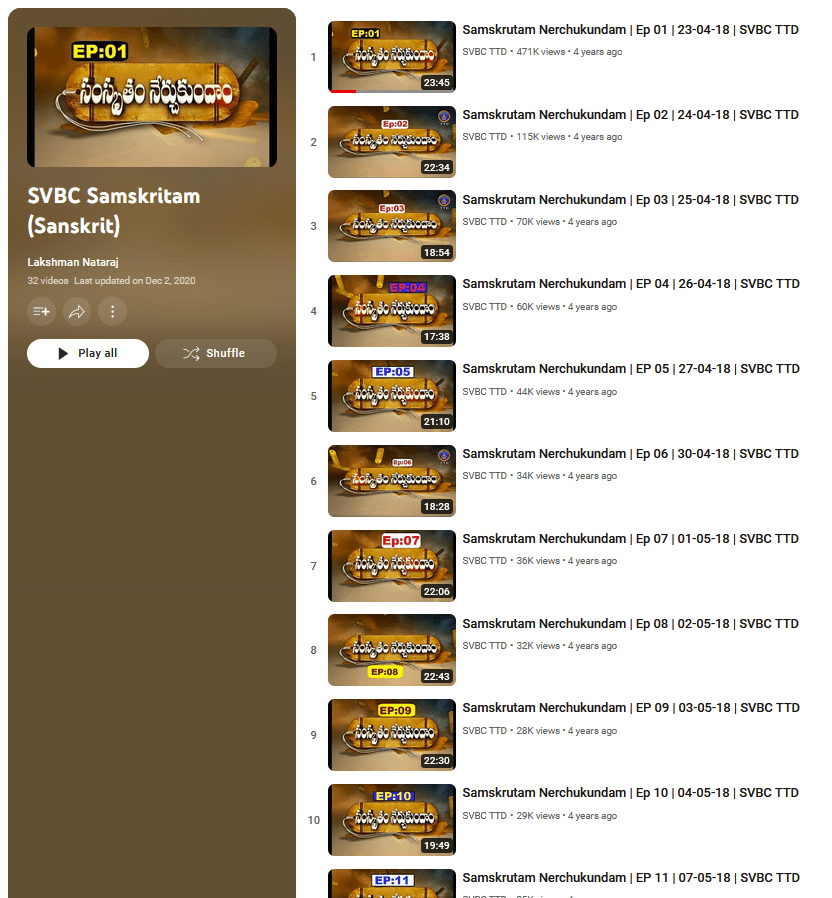












 प्वालसंस्कृतभाण्डारम्। PvaalSamskritam